ñü.media · measurements
less data.
the full picture.
- 7 ×: Less data than Instagram’s own file, at VMAF 59 to HEVC’s 53 at the same rate77×
- 73 kbit/s: Full 720p video with sound, least-data mode7373kbit/s
- 1.9 ×: Faster to encode than full-size HEVC on iPhone1.91.9×
- 240 fps: Ultra, rebuilt to 4K on the host’s own Mac240240fps
Benchmarks: the 720p reel encoded on iPhone Air with iOS 26.6.1; least data and Ultra on a Mac with M1 Pro, 11 October 2026. Raw results sit beside each chart below.
nu.media sends a smaller picture, and the receiving iPhone’s Neural Engine rebuilds the full one.
how it works
nu.media sends video in two layers. The base layer is the video at half size, encoded by your iPhone’s hardware HEVC encoder; it is what crosses the network. The receiving iPhone’s Neural Engine then rebuilds the full picture. The measurements here show the base layer alone, and the full picture rebuilt with Apple’s built-in super resolution on the Neural Engine.
what the scores say
- The base layer alone scores below full-size HEVC, as expected: it is HEVC at a quarter of the pixels.
- With Apple’s super resolution it looks sharper to the eye, but VMAF scores it lower, because Apple’s model adds texture the original doesn’t have and VMAF counts that as error.
- ñü.media’s own network is trained to restore the original rather than invent detail. Every line on the charts is a benchmark except the dashed ones, which are other codecs’ published estimates.
how we test
- The picture you see: every codec is scored on the decoded frames shown on the receiving phone, so nu.media is scored with its enhancement on, never the base layer alone.
- Two scores, side by side: Netflix’s VMAF as published, unmodified, and a viewer test to ITU-T P.910, where people rate clips without knowing the codec. VMAF is known to under-rate generated detail, so the viewer test is the deciding score when they disagree.
- Same conditions for everyone: the same clips, bitrates and phones, hardware encoders at live-call settings, and the raw results published as JSON beside each chart.
what the receiver rebuilds
The enhancement layer runs on the receiving phone, so what you see is more than what was sent: a 1080p base becomes 4K, 25 frames a second become 120 on a ProMotion screen, and a 10-bit 4:2:0 base in BT.709 becomes 12-bit 4:4:4 in BT.2020 once the residual is applied, tone-mapped to the screen. Where a nu.media stream plays on this site, a small card beside it states what the receiver did, with figures read from the decoder. The Earth video on the home page is ordinary H.264 today, so it carries no card; it will when the browser decoder ships.
colour
- BT.2020 primaries, about 76% of the colours people can see. Display P3, what phones store, is about 45%; sRGB about 36%. That is about 1.7 times P3, not twice: twice P3 would be more than human vision.
- PQ to 10,000 nits and HLG, about six times the iPhone 18 Pro’s 1,600-nit peak, so the same file looks right on later screens.
- 12-bit, 4:4:4 on images and on stored video after the residual: four times the steps per channel and four times the colour samples of the 10-bit 4:2:0 picture a phone or a stream delivers. The live base stays 10-bit 4:2:0, which is what the hardware encoder emits in real time.
depth, for every picture
- Measured where there is a sensor: LiDAR and Portrait disparity on the back, TrueDepth on the front, carried as a quarter-resolution depth plane with its confidence.
- Estimated where there isn’t: a photo with no depth, a Live Photo, a received picture. A depth network on the Neural Engine builds the plane, using the picture’s own cues and, for a Live Photo, the parallax in its three seconds of motion. It is marked as estimated, and effects fade out where it is unsure. Codec, model, code and the benchmark against published estimators will be public when built; nothing here is claimed before it is measured.
- On the device only. Depth is computed where the picture already is and travels inside the encrypted object. No server ever sees a picture.
your mark, invisible to everyone else
- What it is: a short code only you can read, embedded invisibly in what you make and share, surviving re-encodes, scaling, crops and screenshots. To anyone else it is noise, and two of your pictures can’t be linked by it.
- What you see: where your picture went. Forwarded by two people in groups you’re in, posted once in a public feed. Your own phone notices this in the places it already visits; nothing crawls for you, and nothing is reported to anyone.
- What it never touches: your calendar, itinerary, notes, drafts, memory, payments, or anything you received rather than made. Those stay in their own encrypted stores and are never marked or matched.
ñü.media
less data. same picture.
Our own image and video codec runs on your iPhone’s Neural Engine. Photos and video take a fraction of the data, keep their resolution and HDR, and still travel inside the stealth rhythm.
The whole reel, two at a time
about 7× less data than Instagram’s own file.so it arrives about 7× faster and costs about 7× less to deliver.
- 7× smallerthan Instagram’s own file, measured
- 7× fasterto arrive on the same connection
- 7× cheaperto deliver, per view
- VMAF 59benchmark; H.265 scores 53 at the same bitrate
All 45 seconds, whole frames, encoded on an iPhone Air over USB. nu.media here is its low-data mode, which sends a smaller picture and rebuilds it on the receiving iPhone. Pick a bitrate and a pair; one side is always the original or nu.media.
original Instagram · 720 × 1280 · 2.44 mbit/s
ñü.media 360 × 640 sent, rebuilt to 720 × 1280 on the Neural Engine · 351 kbit/s · VMAF 59
Source: @deemsterhotline on Instagram, used with thanks: H.264, 720 × 1280 at 30 fps, 2.44 Mbit/s. A dropped frame shows as the previous frame held, and is counted in the label. Rebuilt to 4K (2160 × 3840) from the same bits, the reel scores the same as at 720p: VMAF 87 at 1.4 Mbit/s and 59 at 351 kbit/s, no dropped frames. The iPhone’s low-latency scaler doesn’t accept 720 × 1280 frames, so on the phone that step is a plain upscale; nu.media Ultra, below, rebuilds 4K on the host’s Mac instead. VMAF is Netflix’s 0 to 100 quality score; 93 and up looks the same as the original to most viewers.
4K, two at a time: ñü.media rebuilt to 4K
about 7× less data than YouTube’s 4K stream.so it arrives about 7× faster and costs about 7× less to deliver.
- 7× smallerthan YouTube’s 4K stream, measured
- 7× fasterto arrive on the same connection
- 7× cheaperto deliver, per view
- VMAF 63benchmark; H.265 scores 65 at the same bitrate
nu.media sends a smaller picture and the receiving iPhone rebuilds it to the full 3840 × 2160. Whole frames, shown at 2560 × 1440; use Zoom 3× to see the detail. Encoded on an iPhone Air over USB; AV1 in software on a Mac, because iPhone has no AV1 encoder.
original NASA · 3840 × 2160 · 16 mbit/s
ñü.media 1920 × 1080 sent, rebuilt to 3840 × 2160 · 2.2 mbit/s · VMAF 63
Stunning Aurora Borealis from Space in Ultra-High Definition (4K), NASA, filmed from the International Space Station; public domain. The source is YouTube’s best stream, VP9 at about 16 Mbit/s. nu.media picks the base size that scores best at each bitrate and rebuilds it on the receiving iPhone’s Neural Engine; Apple’s scaler, measured here, stops at 1920 × 1080, so in these runs the last step to 4K is a plain upscale.
Measured 11 October 2026 on a Mac with M1 Pro. Least data: HEVC at 57 kbit/s plus Opus sound at 16 kbit/s, 73 kbit/s in all; at 30 fps even the coarsest HEVC needs about 96 kbit/s for 720p, so it sends 10 frames a second and the receiving device rebuilds 30. At this rate a full 720p picture breaks into blocks; ñü.media’s low-data mode, which sends a smaller picture, looks softer instead (VMAF 15 at 46 kbit/s). Ultra: the host’s own Mac rebuilt every frame 4× with Apple’s on-device super resolution, then made seven new frames between each pair with Apple’s frame-rate conversion, before sending; nothing ran on a server. The file carries 240 frames a second; your screen shows as many as its refresh rate allows (120 Hz on ProMotion). VMAF compares each with the original at 720p and 30 fps and counts generated detail as error, so Ultra scores 72 though it shows a little more detail. Ultra needs a browser that plays HEVC. Source: @deemsterhotline on Instagram, used with thanks. How we measure, and the files to check it yourself.
- avid DNxHR SQ Mac, ffmpeg578 Mbit/s 260 GB/h · VMAF 100
- Apple ProRes 4444 Mac, ffmpeg531 Mbit/s 239 GB/h · VMAF 100
- Apple ProRes 422 HQ Mac, ffmpeg450 Mbit/s 202 GB/h · VMAF 100
- Apple ProRes 422 Mac, ffmpeg381 Mbit/s 171 GB/h · VMAF 100
- Apple ProRes 422 LT Mac, ffmpeg284 Mbit/s 128 GB/h · VMAF 100
- avid DNxHR LB Mac, ffmpeg180 Mbit/s 81 GB/h · VMAF 100
- Apple ProRes 422 proxy Mac, ffmpeg114 Mbit/s 51 GB/h · VMAF 99
- AV1, real time best measured point4.2 Mbit/s 1.9 GB/h · VMAF 92
- h.265 (HEVC), iPhone hardware best measured point2.8 Mbit/s 1.3 GB/h · VMAF 65
- ñü.media, measured benchmark, iPhone Air2.2 Mbit/s 1.0 GB/h · VMAF 63
ProRes and DNxHR are editing formats: near-perfect quality (VMAF 99 and up here) at hundreds of megabits per second. Every row is a benchmark on the same 4K clip; nu.media is measured on iPhone Air. khėnsu.ñü doesn’t carry camera RAW.
- dropbox ProRes 422 HQ master, 202 GB5.4 hUpload at 100 Mbit/s, then download at 500 Mbit/s. Dropbox holds the file and the keys; it knows who sent what to whom.
- IBM aspera ProRes 422 HQ master, 202 GB27 minFASP at line rate, 1 Gbit/s at both ends. Encrypted in transit; the server operator holds the file and sees who sent it.
- khėnsu.ñü, bit-exact the same master, 202 GB9.0 hConstant stream through your own node, 50 Mbit/s. Nobody: end to end, and no one sees the sender, the recipient or the file name.
- khėnsu.ñü, ñü.media ñü.media at its best measured point (VMAF 63), 1.0 GB3 minSame stream; the file is 207× smaller. Nobody, the same as above.
Assumptions: a 100 Mbit/s upload and 500 Mbit/s download for Dropbox, 1 Gbit/s at both ends for Aspera, and a 50 Mbit/s constant stream through your own khėnsu node. The mix network adds a few seconds of delay at the start, not per byte. Sending the exact same bytes is not faster than Aspera on a fast line: the gain comes from sending the picture in nu.media at native resolution instead of the editing master. Free on khėnsu.ñü: there is no per-gigabyte fee.
original green screen, 8K source shown at 2560 × 1440
ñü.media green keyed out, edges despilled, new background
Demo of the green-screen path, keyed with a chroma key and despill. The key runs at 258 or more frames a second at 4K on a 2021 M1 Pro, so it costs the viewer almost nothing; timings for every step are below. Foreground: “Chicken fillet roll green screen”, Wikimedia Commons, CC0, 7680 × 4320. Background: Rick Astley, “Never Gonna Give You Up” (1987), © Sony Music Entertainment, a short silent excerpt used as a meme.
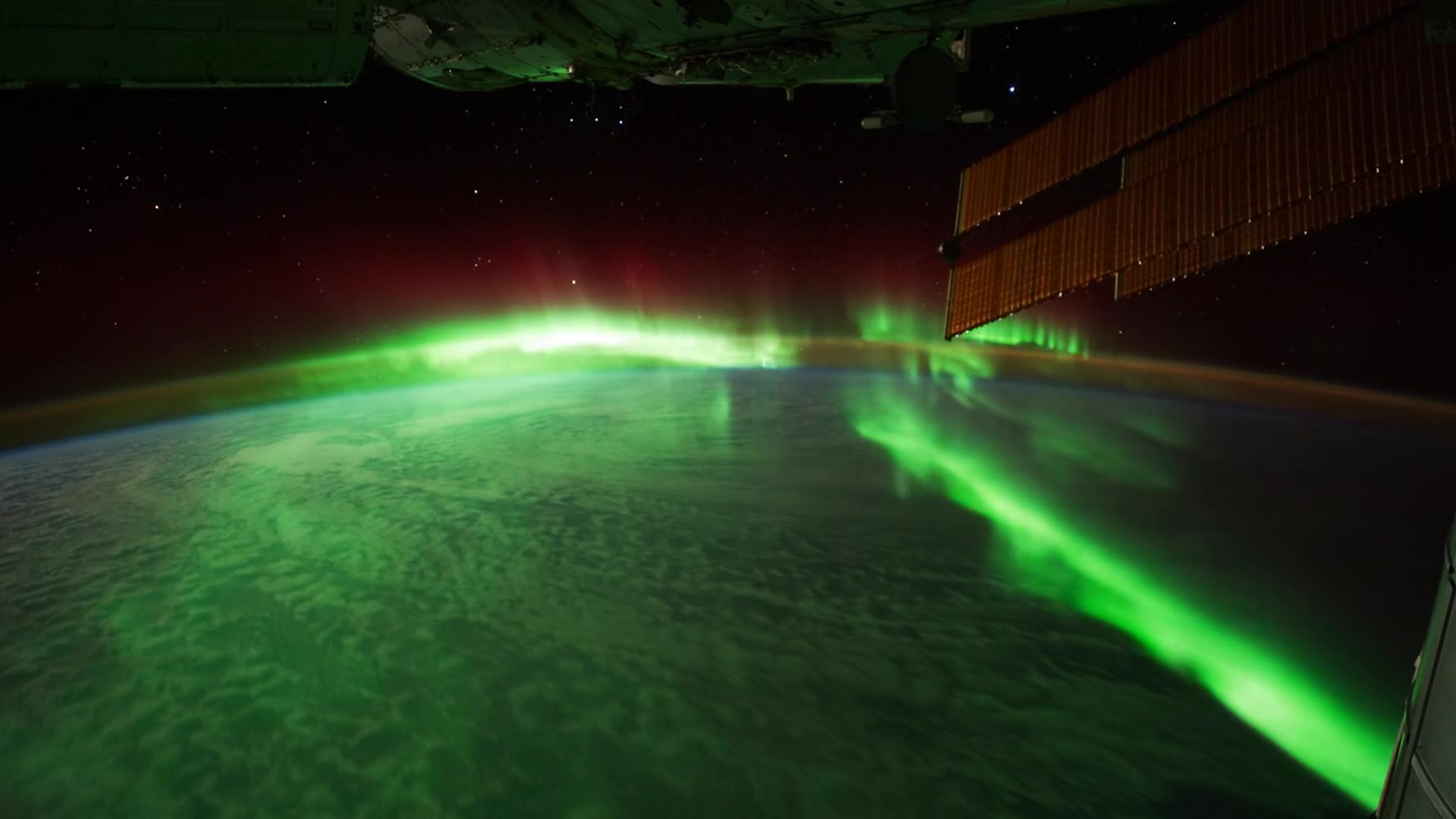
original aurora over the night side, filmed from the ISS
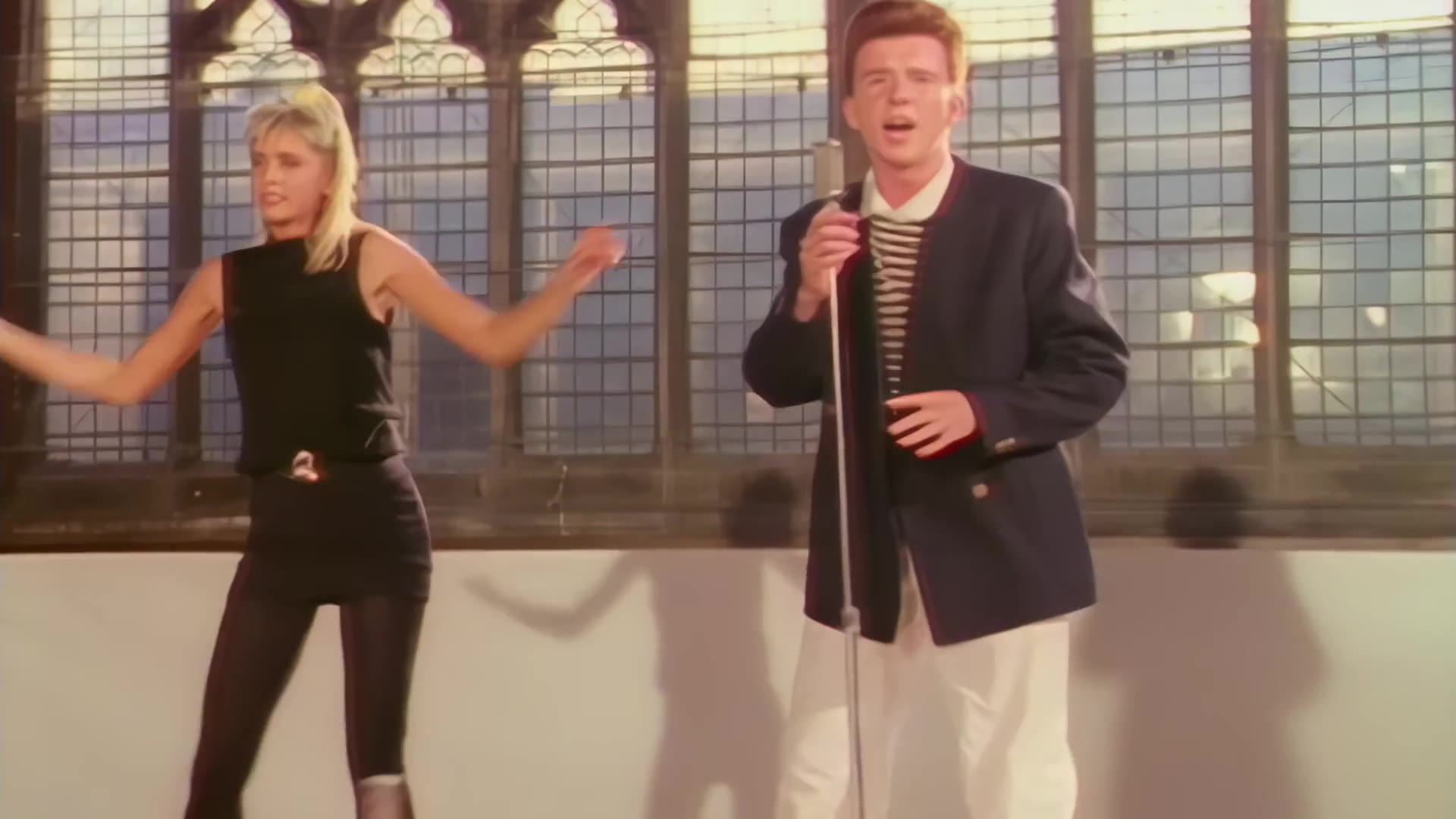
ñü.media black keyed out, light laid over a new background
ñü.media, with AI effects glow, soft shadows, aurora gradients and lyrics written in light, all drawn live on this device
Composited live in your browser with WebGL; nothing is rendered on a server. Both clips were filmed at 30 fps and raised to 120 fps with Apple’s on-device frame-rate conversion on a Mac, so they move smoothly on 120 Hz screens. Light: NASA, ISS Expedition 29 aurora time-lapse, 17 September 2011, public domain. Background: Rick Astley, “Never Gonna Give You Up” (1987), © Sony Music Entertainment, a short silent excerpt used as a meme.
- Ray-traced film framesToy Story 4: 60 to 160 render-farm hours per 4K frame (Pixar)18,000+ farm hours
- Rotoscoping by handAbout 15 frames a day for a skilled artist (Roto++, SIGGRAPH 2016)20 working days
- ñü.media Ultra rebuild, on the hostApple’s super resolution to 4K: 0.93 frames a second on an M1 Pro5.4 min
- Decoding the video itselfHardware HEVC, the 4K Ultra file, M1 Pro: 138 frames a second2.2 s
- AI cut-out, people onlyRobust Video Matting at 4K, 154 frames a second on a desktop RTX 3090, model time only1.9 s
- ñü.media light key with glow and shadows4K, in this browser’s GPU on an M1 Pro: 170+ frames a second1.8 s
- Encoding ñü.mediaHardware HEVC at 720 × 1280 on an iPhone Air: 203 frames a second1.5 s
- ñü.media green-screen key4K, in this browser’s GPU on an M1 Pro: 258+ frames a second1.2 s
why the key is this fast
- The hard part happened when it was filmed. A green screen or a black sky already separates the subject. A rotoscope artist or an AI model has to work out, frame by frame, where the person ends; a key only has to read the colour of each pixel.
- One pass, on the frame already decoded. The key, glow and shadows are a single small program that runs on every pixel at once on the GPU, reading the frame the video decoder has just put there. Nothing is copied back, saved or sent anywhere.
- Light that looks right, not light that is simulated. The glow and shadows blur the light a few dozen times per pixel. Ray tracing follows millions of light paths through a whole 3D scene to get every reflection physically right, which is why a film frame takes hours on a render farm.
- Transparency travels with the video. nu.media carries the cut-out edge in the stream, so the receiver composites; it never recomputes it.
where it isn’t a replacement
A key needs a clean background. Footage with no green screen, hair against a busy wall or heavy motion blur still needs rotoscoping or an AI matte, and the effects here are a look, not physically accurate light. The slow step is ours too: rebuilding 4K for Ultra takes about 32 times longer than the video on an M1 Pro, which is why it runs once on the host, not on every viewer’s device.
Measured 11 October 2026: keys in Chrome’s WebGL with every frame forced to finish, so real playback is faster; decoding with FFmpeg and VideoToolbox; encoding on an iPhone Air with iOS 26.6.1. Cited:Toy Story 4 render times,Roto++ (Li et al., SIGGRAPH 2016),Robust Video Matting benchmarks. Each row is a different job on different hardware, so compare orders of magnitude, not exact ratios.
- ñü.media
- H.264, iPhone hardware
- H.265 (HEVC), iPhone hardware
- AV1, software on a Mac
- Hollow: encoder dropped frames
Bits for the same picture as H.265 at 4 Mbit/s
- ñü.mediaNot reached
- h.264, iPhone hardwareNot reached
- h.265 (HEVC), iPhone hardware2.8 Mbit/s
- AV1, software on a Mac465 kbit/s
Same as the original (VMAF 93, no dropped frames): ñü.media not reached in this test; H.264 not reached in this test; H.265 (HEVC) not reached in this test; AV1 not reached in this test.
- ñü.media
- H.264, iPhone hardware
- H.265 (HEVC), iPhone hardware
- AV1, software on a Mac
- Hollow: encoder dropped frames
Bits for the same picture as H.265 at 2 Mbit/s
- ñü.media1.4 Mbit/s
- h.264, iPhone hardwareNot reached
- h.265 (HEVC), iPhone hardware1.4 Mbit/s
- AV1, software on a Mac1.6 Mbit/s
Same as the original (VMAF 93, no dropped frames): ñü.media not reached in this test; H.264 not reached in this test; H.265 (HEVC) not reached in this test; AV1 not reached in this test.
A preview lands in the first slot and sharpens as the rest arrive.
- ñü.media base layer only, before the Neural Engine69
- h.264 iPhone hardware53
- h.265 (HEVC) iPhone hardware73
- AV1 software, on a Mac72
VMAF is Netflix’s open video quality score: it compares each video with the original and predicts how people would rate it, 0 to 100. Above 70 looks good on a phone. Why VMAF alone isn’t enough, and how to check our numbers. nu.media sends a half-size base layer; the receiving iPhone’s Neural Engine restores the rest.
720p video, iPhone Air 720 × 1280 portrait, 30 fps
4K video, iPhone Air 3840 × 2160, 30 fps, NASA aurora from the ISS
- H.264, iPhone hardware
- HEVC, iPhone hardware
- AV1 software, real time
- ñü.media base layer only
- ñü.media with Apple super resolution, all on iPhone
- AV2, published estimate
- Learned codec (DCVC-RT), estimate
- ñü.media + super resolution Apple’s model on the Neural Engine, measuredNot reachedYes, all on iPhone
- h.264 iPhone hardware1,135 kbit/sYes, hardware
- ñü.media base layer HEVC at half size, no enhancement1,032 kbit/sYes, hardware
- AV1, real time SVT-AV1 on a Mac780 kbit/sNo AV1 encoder on iPhone
- HEVC iPhone hardware717 kbit/sYes, hardware
- AV2 published estimate546 kbit/sNo: no hardware yet
- learned codec DCVC-RT, estimate507 kbit/sNo: datacenter GPU
Measured on iPhone Air. Apple’s hardware HEVC matches real-time AV1 software at a fraction of the power, so it carries nu.media’s base layer. Apple’s super resolution runs at 459 fps on the Neural Engine, but adds texture the original doesn’t have, so it scores below a plain upscale and never reaches VMAF 80 up to 1.4 Mbit/s. nu.media’s own network is trained to restore the original instead.
- A138
- A1416
- A1516
- A1616
- A17 Pro16
- A1816
- A1916
- A20 Pro2 × 16
Tuned for A20 Pro’s dual 16-core Neural Engine: highest resolution and frame rate. Earlier chips run the same format, with less enhancement. Also on Apple silicon iPad and Mac.
All video figures are benchmarks: VMAF (4K model for 4K) on 6-second clips.H.264 and HEVC from an iPhone Air’s hardware encoder (iOS 26.6.1) at live-call settings; AV1 from SVT-AV1real time on an M1 Pro, as iPhone has no AV1 encoder; nu.media as its half-size base layer, and end to end on iPhone with Apple’ssuper resolution. Only the dashed lines aren’t measured: AV2 (about 30% under AV1, per AOMedia) andDCVC-RT (its authors’ gain over H.266) are scaled from our AV1 curve. Photo results aren’t shown here. Results: 720p,4K.